
History and social studies
Psychology comparison matrix
Compare psychological approaches against a course question using evidence, strengths and limits. The behaviourist model is a starting point only; check its terminology and required content against the current specification, as terms can vary.
Read the material
Compare psychological approaches against a course question using evidence, strengths and limits. The behaviourist model is a starting point only; check its terminology and required content against the current specification, as terms can vary.
Complete resource. Use the preview for diagrams and layout.
Page 1
NAME
CLASS
DATE
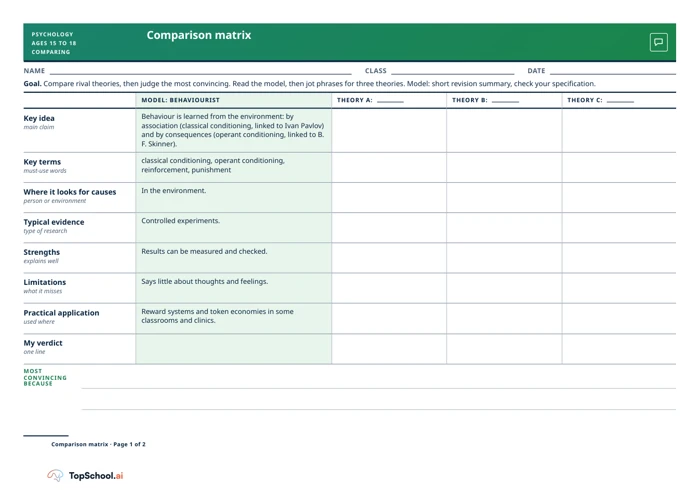
Goal. Compare rival theories, then judge the most convincing. Read the model, then jot phrases for three theories. Model: short revision summary, check your specification.
MODEL: BEHAVIOURIST
THEORY A:
THEORY B:
THEORY C:
Key idea
main claim
Behaviour is learned from the environment: by
association (classical conditioning, linked to Ivan Pavlov)
and by consequences (operant conditioning, linked to B.
F. Skinner).
Key terms
must-use words
classical conditioning, operant conditioning,
reinforcement, punishment
Where it looks for causes
person or environment
In the environment.
Typical evidence
type of research
Controlled experiments.
Strengths
explains well
Results can be measured and checked.
Limitations
what it misses
Says little about thoughts and feelings.
Practical application
used where
Reward systems and token economies in some
classrooms and clinics.
My verdict
one line
MOST
CONVINCING
BECAUSE
Comparison matrix · Page 1 of 2
PSYCHOLOGY
AGES 15 TO 18
COMPARING
Comparison matrix
Page 2
NAME
CLASS
DATE
APPROACH MENU: PICK THREE, OR USE OTHERS FROM YOUR COURSE
Cognitive
mental processes such as memory and
thinking, often compared to
information processing
Biological
genes, brain structure and chemicals in
the body
Social learning
learning by watching and copying
others, linked to Albert Bandura
Humanistic
personal growth, free will and choice,
linked to Carl Rogers and Abraham
Maslow
Psychodynamic
unconscious mind and early
experience, linked to Sigmund Freud
APPROACH 1:
APPROACH 2:
APPROACH 3:
Key idea
main claim
Key terms
must-use words
Where it looks for causes
person or environment
Typical evidence
type of research
Strengths
explains well
Limitations
what it misses
Practical application
used where
My verdict: most convincing
because
Comparison matrix · Page 2 of 2
PSYCHOLOGY
AGES 15 TO 18
COMPARING
Comparison matrix: your choice
A teaching sequence
Compare psychological approaches using a consistent set of claims, terms, evidence, strengths, limitations and applications.
Review the behaviourist model
Read the behaviourist model and check its claims and terms against the current course specification.
Which claim or term needs checking against your current course?
Complete three course approaches
Choose three approaches from the menu or current course, then complete each row with concise notes.
What concise note fits the same comparison heading for each approach?
Compare evidence, strengths and limits
Compare the type of evidence, what each approach explains well and what it may leave out.
Which question does this approach explain well, and what may it leave out?
Make a question-specific verdict
Write a verdict that names a question or criterion for which one approach is more convincing, rather than giving an unsupported universal ranking. Check that the question and comparison match the current course specification.
What kind of evidence supports your judgement for this particular question?
Before you teach
Look for the thinking behind an answer, choose the support your class needs and leave room for an independent response.
What to look for
Look for accurate course-specific claims across all columns and a verdict tied to a stated criterion. Ask: “What kind of evidence would make this approach convincing for this question?” The behaviourist row is explicitly a short model and is not a substitute for the course specification.
Give a little support
Provide a course-approved glossary and complete one row together. Pupils can use brief phrases or a teacher-selected set of three approaches; keep the same question prompts visible across each column.
Take the idea further
Add a fourth course-approved approach or compare how two approaches might explain the same behaviour. Pupils should identify what evidence each would collect and what its explanation might miss.
Things to keep in mind
The behaviourist row is a short revision model that may omit course-specific detail. Check every claim, term and application against the current specification, then use course materials to compare other approaches.
Keep the idea. Make it yours.
Bring your topic, learning goal and class context to PLAI™, then review what you create.
Ideas to try with your class
Sample teaching perspectives on what to try, what to adapt and what to watch for.
Meet The Creators
Meet a creator whose teaching interests connect with this template.

Helpful Highlighter
The first page models a behaviourist theory across claim, key terms, cause, evidence, strength, limitation and application; pupils then select three approaches from the menu. The final one-line verdict asks which is most convincing and why.
Little Lightbulbs
The matrix keeps the same questions for each approach, making comparison more consistent than disconnected summaries. Pupils aged 15 to 18 still need to check that the selected theories match their course specification.
Paperclip Perspective
Use the completed behaviourist row to model how to compress a theory into phrases before filling the other columns. The three chosen approaches can be named in advance so pupils do not spend the task deciding among the menu.
Pencil Case Pal
The behaviourist row is a short revision summary and cannot replace course teaching or evaluation. Check terminology and examples against the current specification, particularly before treating a classroom application as a complete account of a theory.