
Geography
Coastal town case study: choose a response
For Year 8 Geography pupils, sort case facts from unanswered questions, compare two coastal responses and justify a choice using evidence.
Read the material
For Year 8 Geography pupils, sort case facts from unanswered questions, compare two coastal responses and justify a choice using evidence.
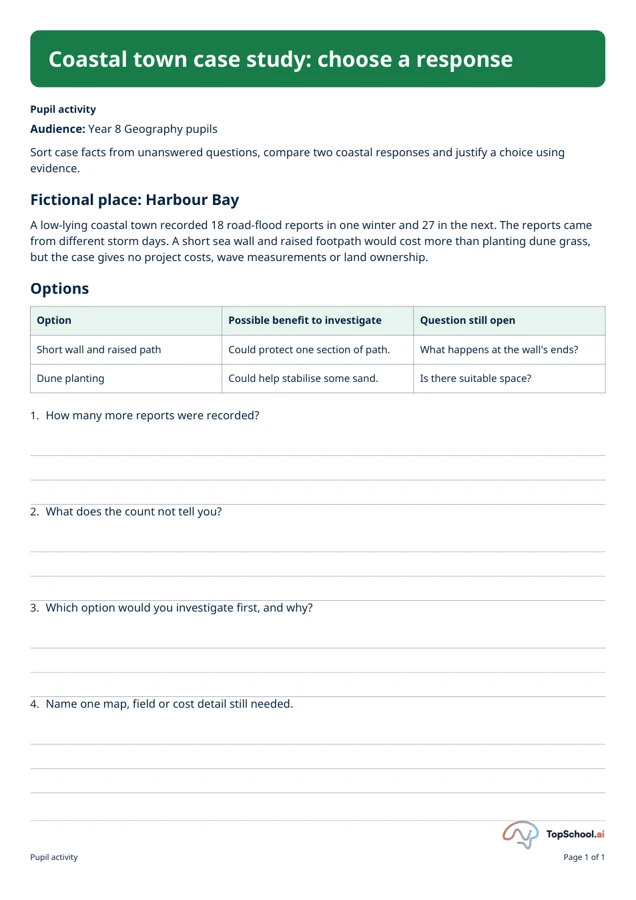
Pupil worksheet. Use the preview for diagrams and layout.
Page 1
Coastal town case study: choose a response
Pupil activity
Audience: Year 8 Geography pupils
Sort case facts from unanswered questions, compare two coastal responses and justify a choice using
evidence.
Fictional place: Harbour Bay
A low-lying coastal town recorded 18 road-flood reports in one winter and 27 in the next. The reports came
from different storm days. A short sea wall and raised footpath would cost more than planting dune grass,
but the case gives no project costs, wave measurements or land ownership.
Options
Option
Possible benefit to investigate
Question still open
Short wall and raised path
Could protect one section of path.
What happens at the wall's ends?
Dune planting
Could help stabilise some sand.
Is there suitable space?
1. How many more reports were recorded?
2. What does the count not tell you?
3. Which option would you investigate first, and why?
4. Name one map, field or cost detail still needed.
Pupil activity
Page 1 of 1
A teaching sequence
Sort case facts from unanswered questions, compare two coastal responses and justify a choice using evidence.
Compare reports and options
Calculate the change in flood reports from 18 to 27. Compare the two response options in the table.
Does the rise in reports tell you how severe the floods were?
List the missing evidence
State what the case does not tell you.
What cost, map or wave information is absent from the case?
Recommend an investigation
Recommend a next step and name the evidence that would help.
What evidence would help you test your first-choice option?
Before you teach
Look for the thinking behind an answer, choose the support your class needs and leave room for an independent response.
What to look for
Reports rose by 9, but that alone does not show the cause or prove a wall will work. Ask, “What extra information would you need?”
Give a little support
Provide a change-calculation frame and separate a recorded fact from a prediction.
Take the idea further
Propose a map or field check that could test one unanswered question.
Things to keep in mind
Harbour Bay and its figures are fictional, not real coastal evidence or an engineering recommendation.
Keep the idea. Make it yours.
Bring your topic, learning goal and class context to PLAI™, then review what you create.
Ideas to try with your class
Sample teaching perspectives on what to try, what to adapt and what to watch for.
Meet The Creators
Meet a creator whose teaching interests connect with this template.
Kind Check-In
Harbour Bay’s reports rise from 18 to 27, but the worksheet states they came from different storm days. Pupils are asked both to calculate the nine-report difference and to explain what that count cannot tell them.
Board Eraser
The Year 8 Geography task compares a short wall and raised path with dune planting, while listing unresolved questions about wall ends and available space. It makes investigation of evidence part of choosing an option.
Planning List
A two-column note of “case fact” and “question still open” would help pupils avoid treating the possible benefits as established outcomes. The final prompt accepts a choice to investigate first, supported by one missing map, field or cost detail.
Organised Pile
No project costs, wave measurements or land ownership are given, and the two winters may not be comparable. The page supports a preliminary enquiry choice, not a claim that one intervention is safer or more cost-effective.