
Business and economics
Business model canvas
Map how a proposed small enterprise creates, provides and pays for value, then test a risky assumption. The landscape A4 workbook includes a nine-block canvas, a fictional school-bakes example and prompts for risk, payer, pitch and revision.
Read the material
Map how a proposed small enterprise creates, provides and pays for value, then test a risky assumption. The landscape A4 workbook includes a nine-block canvas, a fictional school-bakes example and prompts for risk, payer, pitch and revision.
Complete resource. Use the preview for diagrams and layout.
Page 1
NAME
CLASS
DATE
Your idea. Name a business or school mini-enterprise:
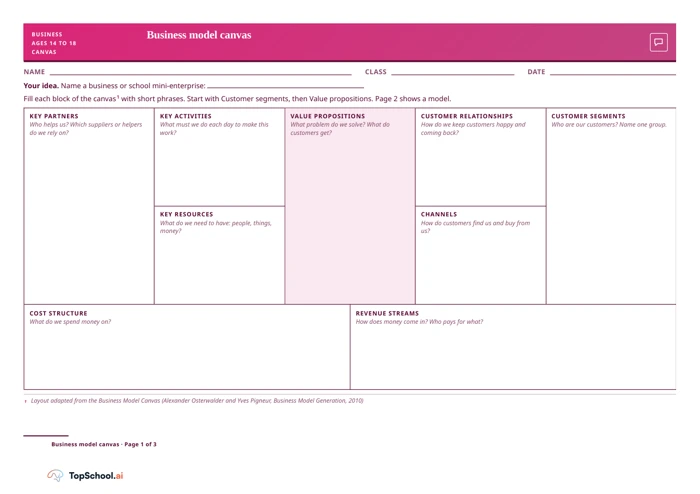
Fill each block of the canvas1 with short phrases. Start with Customer segments, then Value propositions. Page 2 shows a model.
KEY PARTNERS
Who helps us? Which suppliers or helpers
do we rely on?
KEY ACTIVITIES
What must we do each day to make this
work?
KEY RESOURCES
What do we need to have: people, things,
money?
VALUE PROPOSITIONS
What problem do we solve? What do
customers get?
CUSTOMER RELATIONSHIPS
How do we keep customers happy and
coming back?
CHANNELS
How do customers find us and buy from
us?
CUSTOMER SEGMENTS
Who are our customers? Name one group.
COST STRUCTURE
What do we spend money on?
REVENUE STREAMS
How does money come in? Who pays for what?
1 Layout adapted from the Business Model Canvas (Alexander Osterwalder and Yves Pigneur, Business Model Generation, 2010)
Business model canvas · Page 1 of 3
BUSINESS
AGES 14 TO 18
CANVAS
Business model canvas
Page 2
Class Lantern Bakes is a fictional school mini-enterprise selling cakes at break time. It is invented for this sheet. Read each block of the canvas1, then answer the questions below.
KEY PARTNERS
School kitchen team
KEY ACTIVITIES
Baking, selling
KEY RESOURCES
Ingredients, a table, a float
VALUE PROPOSITIONS
Fresh, affordable treats made by
students
CUSTOMER RELATIONSHIPS
Friendly service, regular days
CHANNELS
A stall at break
CUSTOMER SEGMENTS
Students and staff
COST STRUCTURE
Ingredients, packaging
REVENUE STREAMS
Sales
LOOK CLOSELY
Who pays? Name one cost and its
block. Which block would you
improve?
WHO PAYS?
A COST
IMPROVE
1 Layout adapted from the Business Model Canvas (Alexander Osterwalder and Yves Pigneur, Business Model Generation, 2010)
Business model canvas · Page 2 of 3
BUSINESS
AGES 14 TO 18
CANVAS
Worked example: Class Lantern Bakes
Page 3
NAME
CLASS
DATE
1
Riskiest assumption
Look at your page 1 canvas.
RISKIEST BLOCK
WHY RISKY?
2
Who pays?
Is it the same person who uses it?
WHO PAYS
3
What could go wrong?
Name a problem and a fix.
RISK AND FIX
4
One-sentence pitch
Fill the gaps in your own words.
We help
 who want
by
5
Improve it
One change, then re-check.
CHANGE I WILL
MAKE
Business model canvas · Page 3 of 3
BUSINESS
AGES 14 TO 18
QUESTIONS
Test your canvas
A teaching sequence
Describe the main parts of a business model and identify an assumption or risk that needs testing.
Define customer and value
Define one customer group and the value the enterprise proposes to offer; add short phrases to the canvas blocks.
Which customer problem does your proposed offer address?
Connect the canvas blocks
Work across partners, activities, resources, relationships and channels, then record costs and revenue.
Who pays, and which resources create a cost?
Question the fictional example
Read Class Lantern Bakes as a fictional example; identify who pays, a cost and a block that could be improved.
Which block in Class Lantern Bakes needs more information?
Test the riskiest assumption
Return to the pupil’s own canvas, name its riskiest assumption, distinguish payer from user if needed and write a one-sentence pitch. Choose a small test for the riskiest assumption.
What evidence would show that a customer wants this offer?
Before you teach
Look for the thinking behind an answer, choose the support your class needs and leave room for an independent response.
What to look for
Look for a plausible link between customer, value, activities, resources, costs and revenue, then an assumption that can be tested. Ask: “What evidence would show that this customer wants the offer?” Class Lantern Bakes is explicitly fictional and should not be mistaken for a real enterprise example.
Give a little support
Use the fictional example to teach one block at a time, then provide word prompts such as people, tasks, materials, payments and costs. Pupils can sketch or discuss an idea before writing in the canvas.
Take the idea further
Ask pupils to identify the highest-risk assumption and design a small, ethical way to learn about it before spending money. They can revise one canvas block using what they find and explain how the change affects costs or value.
Things to keep in mind
The worked example is explicitly invented, and its details should stay separate from real school activity. The canvas is a planning framework, not financial, legal or market advice. The layout attribution and usage rights need review before publication.
Keep the idea. Make it yours.
Bring your topic, learning goal and class context to PLAI™, then review what you create.
Ideas to try with your class
Sample teaching perspectives on what to try, what to adapt and what to watch for.
Meet The Creators
Meet a creator whose teaching interests connect with this template.

Five More Minutes
The first page gives nine business-model blocks and asks learners to start with customer segments and value propositions. A fictional cake stall on page 2 fills the blocks, then asks who pays, what costs money and which block to improve.
Bright Idea Break
For ages 14 to 18, the three-page canvas links customers, offer, partners, activities, resources, relationships, channels, costs and revenue. The example gives a shared case before pupils plan their own business or school mini-enterprise.
Margin Note
The instruction to use short phrases can keep the nine-box canvas manageable. Working through the Class Lantern Bakes example first gives a concrete way to distinguish a customer group from a channel or a revenue stream.
Chalk & Chai
The cake-stall case is invented, and its brief outline is not evidence that the model would be viable. A next step should test assumptions about demand, costs and school permissions with relevant real information.