
Languages and literacy
Book review and reading log
Record finished books in a ten-row log, then write two short reviews with an intended reader and a reason. A five-feature challenge offers another way to select and record books from the titles pupils can access.
Read the material
Record finished books in a ten-row log, then write two short reviews with an intended reader and a reason. A five-feature challenge offers another way to select and record books from the titles pupils can access.
Activity. Use the preview for diagrams and layout.
Page 1
NAME
CLASS
LOG STARTED
LEARNING GOAL
Keep a record of my reading and share
what I think.
SUCCESS CRITERIA
I can record the title and author of each book.
I can rate a book and give a reason.
I can write a short review to help a friend choose.
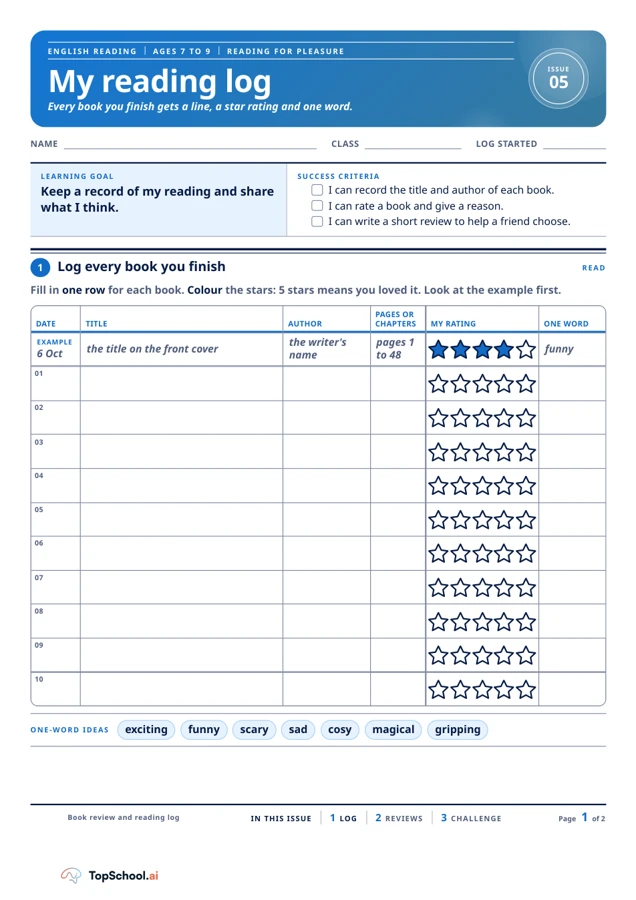
Fill in one row for each book. Colour the stars: 5 stars means you loved it. Look at the example first.
DATE
TITLE
AUTHOR
PAGES OR
CHAPTERS
MY RATING
ONE WORD
the title on the front cover
the writer's
name
pages 1
to 48
funny
ONE-WORD IDEAS
exciting
funny
scary
sad
cosy
magical
gripping
Book review and reading log
IN THIS ISSUE
1 LOG
2 REVIEWS
3 CHALLENGE
E N G L I S H R E A D I N G
AG E S 7 TO 9
R E A D I N G F O R P L E A S U R E
My reading log
Every book you finish gets a line, a star rating and one word.
ISSUE
05
1
Log every book you finish
R E A D
EXAMPLE
6 Oct
01
02
03
04
05
06
07
08
09
10
Page 1 of 2
Page 2
Pick two books from your log. Write your name after By. Finish each sentence and say why.
REVIEW NO. 1
BY
TITLE
AUTHOR
This book is about ...
My favourite character is ... because ...
MY RATING
I would recommend it to ...
REVIEW NO. 2
BY
TITLE
AUTHOR
This book is about ...
My favourite character is ... because ...
MY RATING
I would recommend it to ...
Find a book for each feature. Tick the box and write the title on the lines.
FEATURE 1
A book with an
animal
FEATURE 2
A funny book
FEATURE 3
A non-fiction
book
FEATURE 4
A poem or poetry
book
FEATURE 5
A book from
another country
Book review and reading log · Review desk
I S S U E 0 5
B O O K R E V I E W S
R E V I E W D E S K
Write two book reviews
2
Review two books from your log
W R I T E
3
Reading challenge: five features
R E A D
Page 2 of 2
A teaching sequence
Record reading, support an opinion with a reason and recommend books to an audience.
Record your reading choice
Fill one row for a finished book with its date, title, author, pages or chapters, a star rating and one describing word.
Which moment in the book shaped your one-word description?
Review two books
Choose two books from the log and use the review frames to explain what each is about and who might enjoy it.
Who might enjoy each book, and why?
Support a personal opinion
Give each opinion a reason, such as a character or feature that shaped the response.
Which character or feature gives a reason for your rating?
Explore the five features
Try the five-feature challenge by finding a book for each category and recording its title. Point to a specific moment in the chosen book before recommending it to a reader.
What accessible book fits the category you have chosen?
Before you teach
Look for the thinking behind an answer, choose the support your class needs and leave room for an independent response.
What to look for
Look for complete book details, an opinion supported by a reason and a clear intended reader for each recommendation. Ask: “Which part made you choose that rating?” The challenge records range, not reading attainment, and its access depends on which books pupils can reach.
Give a little support
Use the example row to model where information appears in a book and provide a small selection for pupils who need help choosing. Offer oral review rehearsal, then scribe or use sentence starters without supplying the opinion for the pupil.
Take the idea further
Use the completed log to compare two books with a partner, then write a recommendation for a defined reader. Pupils can set a personal reading question for the next book rather than turning the log into a quota.
Things to keep in mind
A reading log records books pupils choose; it is not a measure of reading ability. Clarify what “from another country” means and offer books pupils can access.
Keep the idea. Make it yours.
Bring your topic, learning goal and class context to PLAI™, then review what you create.
Ideas to try with your class
Sample teaching perspectives on what to try, what to adapt and what to watch for.
Meet The Creators
Meet a creator whose teaching interests connect with this template.

Storytime Sidekick
The log records date, title, author, pages or chapters, rating and one describing word, then asks the pupil to choose two logged books for fuller reviews. The final five-feature challenge reuses the log to find examples.
Chalk Dust & Checklists
For ages 7 to 9, the pages connect reading records to recommendations for a friend. Requiring a reason after the rating makes the review more informative than a star count, while the challenge invites pupils to browse their own list again.
Thoughtful Pause
The example row and one-word bank make the first log entry concrete. A pupil can complete the factual fields before adding an opinion, then use the sentence starters to describe a character or recommend a book.
Planning List
The rating describes one reader’s response and should not stand in for the book’s suitability for everyone. The log covers books pupils finish; clarify how to record a book they stop partway through if that matters to the class.