
Languages and literacy
Book recommendation poster
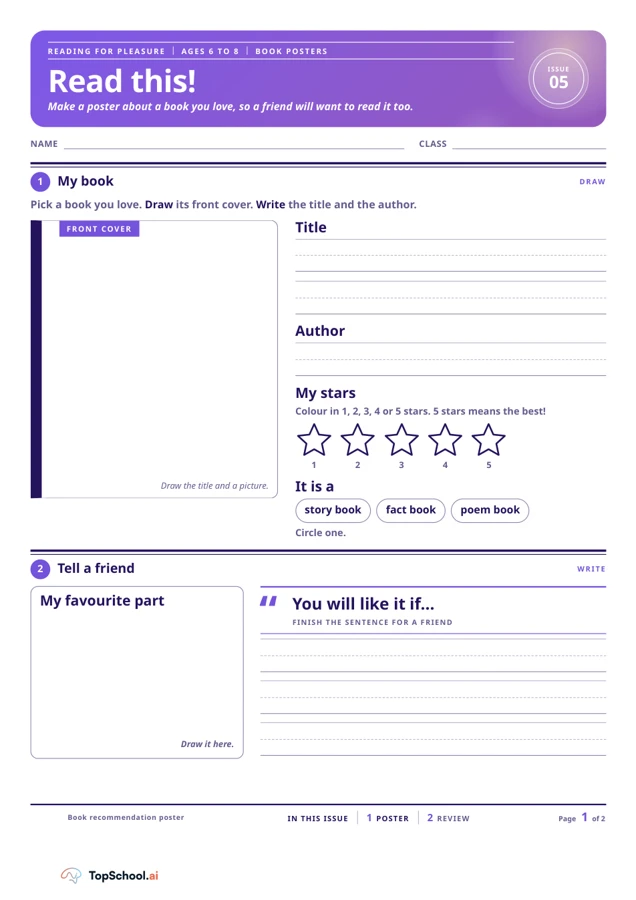
Invite young readers to make a poster that helps a friend decide whether to try a book. The A4 poster combines a cover drawing and recommendation with a short review of how the book felt and a reason for recommending it.
Read the material
Invite young readers to make a poster that helps a friend decide whether to try a book. The A4 poster combines a cover drawing and recommendation with a short review of how the book felt and a reason for recommending it.
Activity. Use the preview for diagrams and layout.
Page 1
NAME
CLASS
Pick a book you love. Draw its front cover. Write the title and the author.
Title
Author
My stars
Colour in 1, 2, 3, 4 or 5 stars. 5 stars means the best!
1
2
3
4
5
It is a
story book
fact book
poem book
Circle one.
My favourite part
Draw it here.
Book recommendation poster
IN THIS ISSUE
1 POSTER
2 REVIEW
R E A D I N G F O R P L E A S U R E
AG E S 6 TO 8
B O O K P O S T E R S
Read this!
Make a poster about a book you love, so a friend will want to read it too.
ISSUE
05
1
My book
D R AW
FRONT COVER
Draw the title and a picture.
2
Tell a friend
W R I T E
You will like it if...
FINISH THE SENTENCE FOR A FRIEND
“
Page 1 of 2
Page 2
NAME
CLASS
LEARNING GOAL
Tell a friend about a book and why
they might enjoy it.
SUCCESS CRITERIA
I can show a book's title, author and cover.
I can say how a book made me feel.
I can give a reason with "because".
Look at each face. Circle Yes, A bit or No.
Funny
Did it make you laugh?
Yes
A bit
No
Exciting
Did you want to read on?
Yes
A bit
No
Scary
Did it make you jump?
Yes
A bit
No
Sad
Did it make you feel sad?
Yes
A bit
No
My favourite character is...
I would tell a friend to read it because...
WORD BANK
brave
kind
silly
clever
magic
cosy
exciting
funny
EDITOR'S CHECKLIST
My cover has a
title.
I coloured my
stars.
I used "because".
GO FURTHER
Read your poster to a friend. Ask them: "Would you like to read this book?"
Book recommendation poster · Review desk
I S S U E 0 5
B O O K P O S T E R S
R E V I E W D E S K
My mini book review
3
How did the book feel?
T H I N K
4
Tell us more
W R I T E
Page 2 of 2
A teaching sequence
Create a book recommendation that gives identifying details, a personal response and a reason a friend might enjoy the book.
Introduce your book
Draw the book cover and record the title and author; choose the book type and colour one to five stars.
Can your friend find both the title and the author?
Choose a favourite part
Draw the favourite part and finish “You will like it if…” for a possible friend reader.
What does your drawing show a reader might enjoy?
Describe your response
Respond to the feeling questions and name a favourite character if the book includes one.
Which feeling, if any, would you like to explain?
Recommend with a reason
Complete the recommendation sentence with because, use the word bank if helpful and read the poster to a friend. Link the recommendation to that reader’s preference.
What part of the book might suit your friend's interests?
Before you teach
Look for the thinking behind an answer, choose the support your class needs and leave room for an independent response.
What to look for
Look for accurate book details and a recommendation that gives a reason connected to the reader’s preference. Ask: “What part of the book might your friend enjoy?” The star score is a personal response, not an objective measure of a book’s quality.
Give a little support
Read each prompt aloud, allow drawing or oral rehearsal before writing and offer the word bank as an option. A partner or adult can record a pupil’s recommendation while the pupil chooses the message and drawing.
Take the idea further
Ask the friend to choose one book from two posters and explain what information helped. The pupil can revise the recommendation for a different reader, such as someone seeking a funny story or a factual topic.
Things to keep in mind
The rating and reflection prompts invite a personal response. Do not treat them as a fixed judgement or require pupils to share private feelings.
Keep the idea. Make it yours.
Bring your topic, learning goal and class context to PLAI™, then review what you create.
Ideas to try with your class
Sample teaching perspectives on what to try, what to adapt and what to watch for.
Meet The Creators
Meet the creators whose teaching interests connect with this template. Find an approach to try with your class.

Katie Marchbank
I want reading materials to match what a child is currently learning in phonics, so pupils can practise new knowledge without being asked to decode patterns they have not met yet.
Meet the creator
Lucy Bramwell
Clear explanations and respectful questions give pupils room to learn about relationships and wellbeing without being asked to speak for a family.
Meet the creator
Bright Margins
The two-page poster asks for title, author, cover, a star choice, a favourite part and a sentence for a friend. The review page adds feeling prompts and a “because” reason, so the recommendation has both identifying details and a personal response.
Tea at Breaktime
For ages 6 to 8, the poster moves from drawing a front cover to telling a peer why they might enjoy the book. The word bank (funny, cosy, exciting and others) supports vocabulary without deciding the rating for the pupil.
Good Question
The face choices of Yes, A bit or No give pupils a scaffold for describing whether a book felt funny, exciting, scary or sad. A pupil may point to a word or dictate the reason before completing the friend-facing sentence.
Spare Pencil
The five-star scale is explicitly subjective, with five meaning “the best”; it is not a comparable quality score across pupils. Keep recommendations grounded in the named book and avoid assuming a friend will share the reviewer’s reaction.