
Languages and literacy
Analytical essay planner: how a writer creates isolation
For Years 8 to 12 English pupils, plan a multi-paragraph analytical essay about how a writer creates isolation, using quotations, transitions and a reasoned conclusion.
Read the material
For Years 8 to 12 English pupils, plan a multi-paragraph analytical essay about how a writer creates isolation, using quotations, transitions and a reasoned conclusion.
Pupil worksheet. Use the preview for diagrams and layout.
Page 1
Analytical essay planner: how a writer creates isolation
Pupil activity
Audience: Years 8 to 12 English pupils
Plan a multi-paragraph English analytical essay explaining how a writer creates a sense of isolation, using evidence and transitions from an original passage.
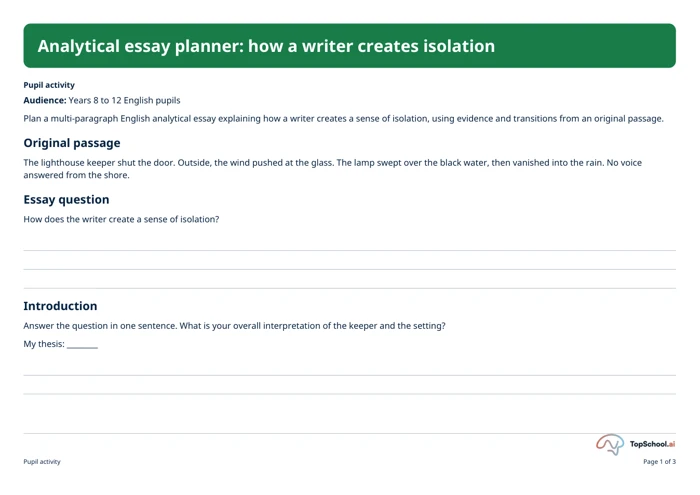
Original passage
The lighthouse keeper shut the door. Outside, the wind pushed at the glass. The lamp swept over the black water, then vanished into the rain. No voice
answered from the shore.
Essay question
How does the writer create a sense of isolation?
Introduction
Answer the question in one sentence. What is your overall interpretation of the keeper and the setting?
My thesis: ________
Pupil activity
Page 1 of 3
Page 2
Analytical essay planner: how a writer creates isolation
Plan three connected body paragraphs
Paragraph
Point that answers the
question
Short quotation
Analyse a word, image or
sentence choice
Link to the argument
1, setting
2, sound or silence
3, development or contrast
Transition into paragraph 2: “Furthermore _____” / “By contrast _____” / my own transition: ________
Pupil activity
Page 2 of 3
Page 3
Analytical essay planner: how a writer creates isolation
Alternative reading
Could the keeper seem determined as well as isolated? Add a quotation, explain the reading and state how it changes or limits your thesis.
Alternative view: ________ Evidence: ________
Conclusion
Return to your main argument. Explain how the three details work together without repeating every point.
Final judgement: ________
Pupil activity
Page 3 of 3
A teaching sequence
Plan a multi-paragraph English analytical essay explaining how a writer creates a sense of isolation, using evidence and transitions from an original passage.
Answer the isolation question
Draft an introduction that answers the question and names the writer’s overall method.
What overall interpretation will your essay test?
Plan distinct evidence paragraphs
Plan three body paragraphs, each with a distinct point, short quotation, word-level analysis and link to the argument.
Which word in your short quotation supports this paragraph's point?
Connect the argument
Choose a transition that shows how paragraph two develops or contrasts with paragraph one.
Does the transition develop the earlier point or contrast with it?
Weigh an alternative reading
Plan a supported alternative reading, then conclude by returning to the question.
Which quotation could support determination as well as isolation?
Before you teach
Look for the thinking behind an answer, choose the support your class needs and leave room for an independent response.
What to look for
A coherent plan could move from the closed door and “black water”, to the silence in “No voice answered”, then to the lamp that “vanished”. Ask, “How does your final paragraph extend the first idea?”
Give a little support
Use the paragraph table one row at a time. Rehearse the claim aloud before adding a short quotation and explaining one precise word.
Take the idea further
Develop the alternative reading that the keeper may be determined, then explain which quotation best supports or limits that interpretation.
Things to keep in mind
The passage is an original classroom text. Check the class specification for required terminology, paragraph count and assessment conventions.
Keep the idea. Make it yours.
Bring your topic, learning goal and class context to PLAI™, then review what you create.
Ideas to try with your class
Sample teaching perspectives on what to try, what to adapt and what to watch for.
Meet The Creators
Meet a creator whose teaching interests connect with this template.

Helpful Highlighter
The original lighthouse passage is short enough to annotate closely, then the three body rows ask for a point, quotation, analysis and link. The alternative reading that the keeper may be determined as well as isolated prevents a one-way interpretation.
Notes Between Bells
The planner supports a multi-paragraph response to “How does the writer create a sense of isolation?” Its sound, setting and development prompts encourage pupils to build an argument across details rather than write three unrelated technique labels.
Spare Pencil
The sentence transitions are optional and sit beside space for a pupil’s own wording. Modelling how “No voice answered from the shore” supports an interpretation can help pupils move from quotation to analysis without prescribing a single thesis.
Planning List
This is a bounded fictional passage, so conclusions should address this extract rather than a whole novel or authorial intention. A next step could ask pupils to compare a second passage and identify what changes in the isolation argument.