How Can Teachers Tell What a Student Actually Understands When AI Helped?
AI-assisted work may look polished without showing everything a student understands. Compare five proportionate follow-up methods and the limits of each.
On this page7 sections
The work looks strong, but what does the student understand?
A student submits a polished piece of work. AI assistance was permitted, disclosed or reasonably possible. The work looks complete, but you still need to know what the student can explain, apply or evaluate.
Start with what the task was meant to show and the evidence you already have. If something important is still unclear, choose the smallest follow-up that directly checks that missing skill. Add the response to the evidence from the submitted work, without treating it as proof of mastery, independent authorship or the precise extent of AI contribution.
The aim is to gather useful evidence of learning. AI detection is a separate issue.
In some tasks, the submitted work may be enough. If students were allowed to use tools to organise information, a clear final output may provide relevant evidence. In another task, polished prose may tell you very little about whether the student understands the reasoning behind it.
AI involvement does not automatically invalidate the work. It may simply mean that you need another piece of evidence before deciding what the student understands.
Start with what the task was meant to show
Before asking the student to do anything else, finish this sentence:
The follow-up needs to test the same skill. If the task assessed mathematical reasoning, an unexpected oral presentation could introduce speaking confidence as an extra demand. If it assessed written argument, an entirely visual response might remove part of the skill you intended to assess.
Check what AI use was permitted as well. A student who used an approved tool for language support is in a different position from one completing a task intended to demonstrate unaided recall. What matters is whether the student has supplied the evidence the task required.
Then look at what you already know. This might include the submitted work, earlier work on the topic, questions asked during the lesson, decisions you observed or explanations the student has already given.
That may be enough. A follow-up should address a real gap in the evidence rather than become an automatic extra task whenever AI might have been involved.
Decide whether another check is worth doing
Try to name the uncertainty precisely.
“I am unsure whether this is their own work” does not tell you which learning check would help. More focused uncertainties do:
- Can the student explain why this method works?
- Can they apply the idea when one condition changes?
- Can they recognise a weakness in the answer?
- Can they explain how AI affected a particular decision?
- Can they revise the work using subject knowledge?
The stakes affect how much additional evidence you need.
For routine feedback, one short question may be enough. Classroom grading may require a little more evidence connected to the marking criteria. A more consequential decision may call for a structured follow-up.
Externally regulated assessments may have specific authentication, documentation or misconduct procedures. For assessments covered by UK awarding organisations, JCQ guidance on AI use in assessments sets expectations for AI use, acknowledgement and authentication.
Collect what is needed for the decision in front of you. More evidence is not automatically better.
AI detector output should not form part of the learning judgement. A peer-reviewed evaluation of AI text-detection tools found serious reliability limitations and concluded that detector reports should not be the only basis for reporting suspected misconduct. A detector score also says nothing about whether a student understands the subject.
If a formal concern remains, use the applicable school or qualification procedure. Keep that process separate from the check of what the student knows or can do.
Choose the smallest useful follow-up
Each method below answers a different kind of uncertainty. They are options rather than a sequence, and most situations should not require all five.
- Useful when
- You need evidence of reasoning or conceptual understanding
- What it can show
- Whether the student can explain one relevant concept, choice or step
- What it cannot prove
- Independent authorship or wider mastery
- Keep it proportionate
- Ask about one targeted part and allow an equivalent response mode
- Useful when
- The task was meant to show application or transfer
- What it can show
- Whether the student can use the same learning when one relevant condition changes
- What it cannot prove
- Who produced the original submission
- Keep it proportionate
- Change only what is necessary and preserve the original skill
- Useful when
- Evaluation, accuracy or improvement matters
- What it can show
- Whether the student can recognise a weakness and make a justified improvement
- What it cannot prove
- Original authorship
- Keep it proportionate
- Use one passage, answer or step rather than requiring a full redraft
- Useful when
- Limited process context would help and collection is permitted
- What it can show
- Selected decisions, revisions or connections between inputs and the final work
- What it cannot prove
- A complete work history or absence of undeclared AI use
- Keep it proportionate
- Request only a representative artefact and avoid universal logs
- Useful when
- Context about the role of AI would help interpret the work
- What it can show
- The student’s account of how and why AI was used
- What it cannot prove
- Mastery, authorship or complete disclosure
- Keep it proportionate
- Use a short, accessible format with a clear purpose
Choose the method that addresses the missing evidence most directly. A longer or more formal check is not necessarily a better one.
Five ways to check understanding after AI use
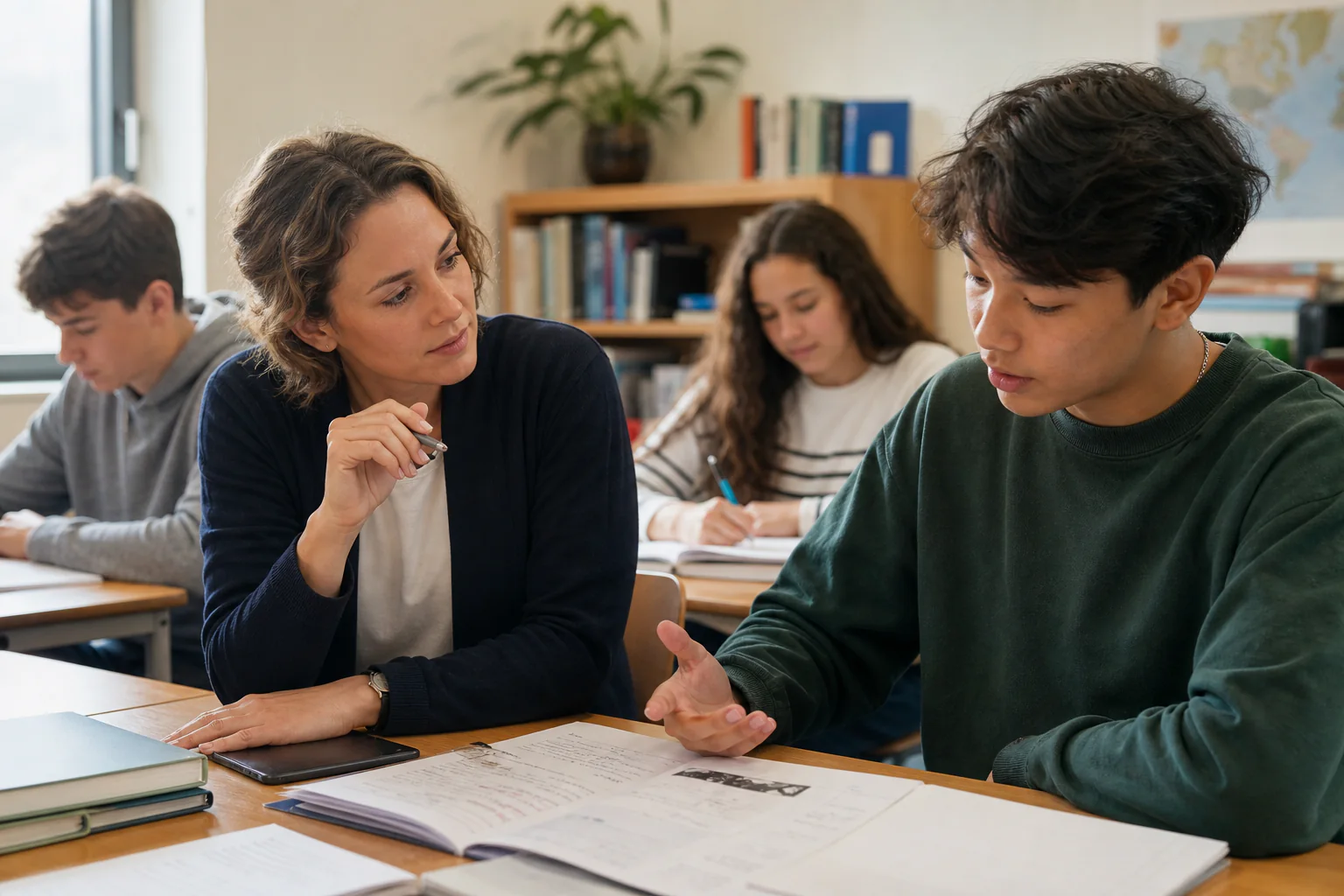
A focused explanation
Keep the question focused on one meaningful choice, concept or step in the submitted work:
Talk me through one decision you made in this answer. What were you trying to achieve, and why did that approach make sense to you?
In a subject where the steps matter, ask what one step contributes and what would happen if it were removed. For a written argument, ask why a particular piece of evidence supports the conclusion.
A focused response adds evidence about the student’s reasoning. It does not establish that they produced the full submission independently or mastered everything covered by the task.
Keep the question narrow. This should not become a general oral defence. Where speaking is not part of the skill being assessed, the student could use a written annotation, audio recording, diagram or supported communication method. CAST’s guidance on action and expression supports varied ways for learners to communicate what they know while keeping the assessed skill in view.
A changed-context question
When the task is meant to show application, change one relevant condition:
If this condition changed, what would you keep, what would you change, and why?
In mathematics or science, the change could be one variable. In humanities, it might be a different source or audience. In a practical subject, it could be a new constraint.
The student’s response can show whether they can transfer the underlying learning. It cannot tell you who created the original submission.
The variation should remain close to the first task. Avoid setting a completely new assessment when one carefully chosen change will answer the question. Any accessibility support should leave the original skill intact.
Critique and revision
Give the student a small, relevant part of the work to examine:
Identify one part of this response that could be challenged or improved. Explain the issue, then revise it.
They might critique a section of their submission, an AI-generated suggestion or a short example provided by the teacher. Look at how they identify the problem, explain their judgement and make the revision.
This gives you evidence of evaluative judgement. IB guidance on AI in learning, teaching and assessment expects students to be able to explain their use of AI and demonstrate understanding, but it does not validate critique or revision as a standalone verification method. It does not show who wrote the first version.
There is rarely a need to request a full redraft. One passage, calculation, claim or step can provide the evidence you need without creating unnecessary work.
Selective process evidence
Use process evidence only when the student’s decisions or revisions matter to the task. Ask for one useful point in the process rather than a complete record:
Show me one point where your work changed direction. What influenced that change?
A selected draft, decision note, source comparison or representative record of an AI interaction may be enough. The purpose is to understand a specific decision, not to reconstruct every action.
These artefacts can provide context about how the work developed. They cannot show that the record is complete, rule out other assistance or prove independent authorship.
Only request material that students were permitted or reasonably expected to retain. Avoid complete prompt histories, private conversations and unnecessary personal information. UNESCO’s guidance on generative AI in education emphasises privacy protection and age-appropriate use. If a process record creates an accessibility barrier, a short conference note or student-selected artefact may work instead.
Student disclosure
A short disclosure can help you interpret how AI contributed:
What did AI help you with? Which decisions did you make yourself, and what did you check or change?
The answer may clarify the purpose of the AI assistance and encourage the student to reflect on how they used it. It does not demonstrate subject mastery, establish authorship or guarantee a complete account.
Explain why you are asking and keep the response brief. A written, spoken or recorded format may be appropriate. Where AI assistance was permitted, disclosure should not be treated as a confession.
Keep the check fair and proportionate
A follow-up should clarify the student’s understanding without adding barriers unrelated to the task. Change the response mode where needed, while preserving the skill being assessed. Collect only what the classroom decision requires, use approved systems and avoid unnecessary personal data.
Rules vary by location and assessment type. In England, Department for Education guidance on AI and school data protection advises schools to check approved tools, consult appropriate data-protection leads and understand how personal data will be used. These requirements do not apply universally to every classroom or jurisdiction.
For school-wide questions about permitted AI use, assessment design and governance, see AI and Assessment in Schools.
A short checklist before you decide
Before adding a follow-up, check:
- What was the task meant to show?
- What relevant evidence do I already have?
- What exactly remains uncertain?
- How consequential is the decision?
- Which one method would add the most relevant evidence?
- Does that method preserve the skill being assessed?
- Is an accessible alternative needed?
- Is any process evidence permitted and necessary?
- Have privacy and safeguarding been considered?
- Am I treating the result as evidence rather than proof?
- Do I now have enough evidence to stop?
- If a formal concern remains, which existing school or qualification procedure applies?
Stop when the available evidence is sufficient for the classroom decision. Do not keep adding checks in pursuit of certainty about authorship or exact AI contribution.