
Study and learning skills
My revision mat
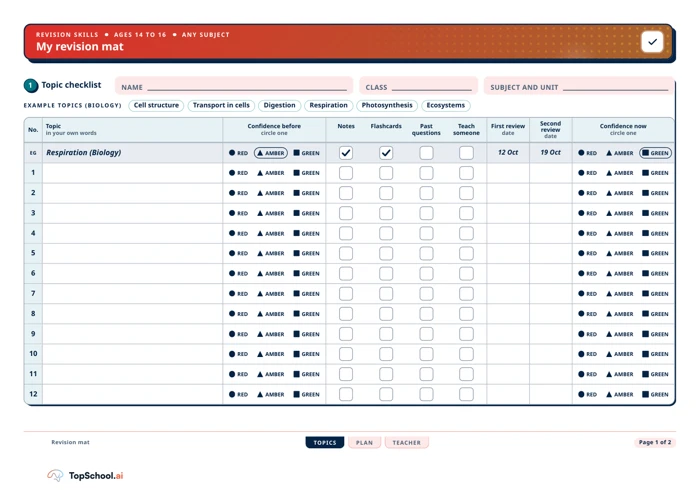
Map topics, choose revision activities, revisit material over a planned sequence and reflect on confidence before and after. The mat helps pupils decide what to do next; confidence marks are self-reports, not proof of mastery.
Read the material
Map topics, choose revision activities, revisit material over a planned sequence and reflect on confidence before and after. The mat helps pupils decide what to do next; confidence marks are self-reports, not proof of mastery.
Complete resource. Use the preview for diagrams and layout.
Page 1
Revision mat
TOPICS
PLAN
TEACHER
Page 1 of 2
REVISION SKILLS
AGES 14 TO 16
ANY SUBJECT
My revision mat
1
Topic checklist
NAME
CLASS
SUBJECT AND UNIT
EXAMPLE TOPICS (BIOLOGY)
Cell structure
Transport in cells
Digestion
Respiration
Photosynthesis
Ecosystems
No.
Topic
in your own words
Confidence before
circle one
Notes
Flashcards
Past
questions
Teach
someone
First review
date
Second
review
date
Confidence now
circle one
EG
Respiration (Biology)
RED
AMBER
GREEN
12 Oct
19 Oct
RED
AMBER
GREEN
1
RED
AMBER
GREEN
RED
AMBER
GREEN
2
RED
AMBER
GREEN
RED
AMBER
GREEN
3
RED
AMBER
GREEN
RED
AMBER
GREEN
4
RED
AMBER
GREEN
RED
AMBER
GREEN
5
RED
AMBER
GREEN
RED
AMBER
GREEN
6
RED
AMBER
GREEN
RED
AMBER
GREEN
7
RED
AMBER
GREEN
RED
AMBER
GREEN
8
RED
AMBER
GREEN
RED
AMBER
GREEN
9
RED
AMBER
GREEN
RED
AMBER
GREEN
10
RED
AMBER
GREEN
RED
AMBER
GREEN
11
RED
AMBER
GREEN
RED
AMBER
GREEN
12
RED
AMBER
GREEN
RED
AMBER
GREEN
Page 2
SUCCESS CRITERIA
I can plan to revisit a topic after a gap
I can rate my confidence honestly
I can pick my weakest three and act
Revision mat
TOPICS
PLAN
TEACHER
Page 2 of 2
REVISION SKILLS
AGES 14 TO 16
ANY SUBJECT
Spaced revision plan
Day 1: Learn it
Done
Date
What I will review:
RED
AMBER
GREEN
Day 3: Recall it
Done
Date
What I will review:
RED
AMBER
GREEN
Day 7: Test it
Done
Date
What I will review:
RED
AMBER
GREEN
Day 21: Check it
Done
Date
What I will review:
RED
AMBER
GREEN
2
My weakest three
Pick the topics with the lowest confidence
1
Topic
My next step
By when
2
Topic
My next step
By when
3
Topic
My next step
By when
3
Self-audit tally
Count your topics
Before
RED
AMBER
GREEN
Now
RED
AMBER
GREEN
Write how many topics sit under each word.
A teaching sequence
Create a topic list, rate confidence before and after revision, schedule review points and choose next steps for the topics that feel least secure.
Name topics and current confidence
List topics using wording the pupil understands and record an initial confidence rating for each.
What does the topic mean in your own words?
Choose review methods and dates
Choose how to revisit each topic from the options shown: notes, flashcards, past questions or teaching it to someone. Add a first and second review date.
Which accurate subject material will you use to check recall?
Schedule recall and checking
Use the spaced plan to schedule a first learning session and later recall, testing and checking sessions. Record the date and topic for each.
Does this plan fit your subject and circumstances rather than promise retention?
Choose three next actions
After review, rate confidence again and tally the colours in the self-audit. Then choose three topics with lower confidence, write one next step for each and set a realistic completion date.
Which lower-confidence topic needs a specific checked practice step?
Before you teach
Look for the thinking behind an answer, choose the support your class needs and leave room for an independent response.
What to look for
Ask the pupil to show which topic they plan to revisit and name the action they will take. Check that dates fit the class timetable and that the next step is specific, such as answering a set of questions, rather than simply “revise more”.
Give a little support
Offer a short, teacher-selected topic list and let pupils choose from two revision methods. Model one row, provide a calendar with review dates, and allow a verbal or digital plan if writing across the wide table is difficult.
Take the idea further
Invite pupils to compare a confidence rating with a low-stakes retrieval check, then decide whether the next review should change. They can reflect on which method helped them notice gaps, without claiming that a rating alone measures learning.
Things to keep in mind
The day intervals are a planning structure, not a guarantee of retention or a prescribed evidence-based schedule for every subject or pupil. Confidence ratings are subjective. Pair the mat with accurate subject materials, accessible methods and teacher feedback.
Keep the idea. Make it yours.
Bring your topic, learning goal and class context to PLAI™, then review what you create.
Ideas to try with your class
Sample teaching perspectives on what to try, what to adapt and what to watch for.
Meet The Creators
Meet a creator whose teaching interests connect with this template.

Open Book Pause
This two-page revision mat lets pupils list topics in their own words, rate confidence before revision, select strategies such as flashcards or past questions, schedule two reviews and record confidence again.
After the Bell
The biology example names cell structure, transport, digestion, respiration, photosynthesis and ecosystems, showing how a broad unit can become a topic checklist. Comparing before and after ratings invites reflection on what to revisit.
Step by Step
Help the pupil choose a short topic list and a strategy suited to each one, then set review dates they can meet. Treat red, amber and green as planning cues rather than labels of ability.
Storytime Sidekick
Confidence ratings are self-reports and do not verify recall or exam readiness. Pair them with retrieval questions or marked work and use the results to decide what to practise next.