
Languages and literacy
Oral presentation planner
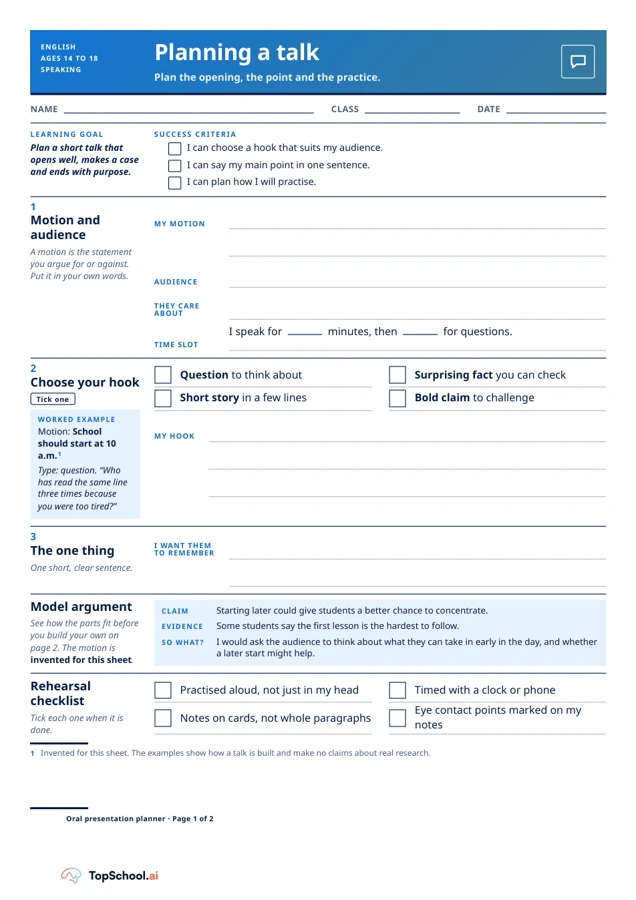
Plan a short persuasive talk by choosing an audience, shaping a hook and stating the point listeners should remember. Pupils then organise claims, evidence and explanations, consider a counter-argument and plan a conclusion. The worksheet labels its school-start example as invented, not real research.
Read the material
Plan a short persuasive talk by choosing an audience, shaping a hook and stating the point listeners should remember. Pupils then organise claims, evidence and explanations, consider a counter-argument and plan a conclusion. The worksheet labels its school-start example as invented, not real research.
Complete resource. Use the preview for diagrams and layout.
Page 1
NAME
CLASS
DATE
LEARNING GOAL
Plan a short talk that
opens well, makes a case
and ends with purpose.
SUCCESS CRITERIA
I can choose a hook that suits my audience.
I can say my main point in one sentence.
I can plan how I will practise.
1
Motion and
audience
A motion is the statement
you argue for or against.
Put it in your own words.
MY MOTION
AUDIENCE
THEY CARE
ABOUT
TIME SLOT
I speak for
 minutes, then
 for questions.
2
Choose your hook
Tick one
WORKED EXAMPLE
Motion: School
should start at 10
a.m.1
Type: question. “Who
has read the same line
three times because
you were too tired?”
Question to think about
Surprising fact you can check
Short story in a few lines
Bold claim to challenge
MY HOOK
3
The one thing
One short, clear sentence.
I WANT THEM
TO REMEMBER
Model argument
See how the parts fit before
you build your own on
page 2. The motion is
invented for this sheet.
CLAIM
Starting later could give students a better chance to concentrate.
EVIDENCE
Some students say the first lesson is the hardest to follow.
SO WHAT?
I would ask the audience to think about what they can take in early in the day, and whether
a later start might help.
Rehearsal
checklist
Tick each one when it is
done.
Practised aloud, not just in my head
Timed with a clock or phone
Notes on cards, not whole paragraphs
Eye contact points marked on my
notes
1 Invented for this sheet. The examples show how a talk is built and make no claims about real research.
Oral presentation planner · Page 1 of 2
ENGLISH
AGES 14 TO 18
SPEAKING
Planning a talk
Plan the opening, the point and the practice.
Page 2
01
Your strongest point.
Claim: what you say.
Evidence: an example or
fact. So what? why it
matters.
CLAIM
EVIDENCE
SO WHAT?
02
Add a different kind of
evidence.
CLAIM
EVIDENCE
SO WHAT?
03
End on a point that links to
your hook.
CLAIM
EVIDENCE
SO WHAT?
vs
Counter-argument. Take
the other side seriously,
then reply.
SOMEONE
MIGHT SAY
MY REPLY
end
Conclusion. Call back to
your hook.
CALL BACK
IN ONE
SENTENCE
CLOSING
LINE
Oral presentation planner · Page 2 of 2
ENGLISH
AGES 14 TO 18
SPEAKING
Building the talk
A teaching sequence
Plan and organise a short oral argument with a clear point, relevant evidence, an explanation, a counter-argument, a reply and a conclusion linked to the opening.
Define motion and audience
Complete the audience and motion boxes. Ask pupils to state the motion in their own words and identify what the audience may care about.
What might this audience care about in the motion?
Choose a supported opening
Choose a hook and draft an opening using the worked example to distinguish claim, evidence and explanation. Identify how the explanation answers So what?
Which part is claim, evidence and explanation in the invented model?
Plan points and a fair reply
Plan three points with claim, evidence and explanation, then consider what someone on the other side might say and how to reply fairly.
What source supports the factual claim in your own argument?
Rehearse a clear ending
Write a conclusion that calls back to the hook, then rehearse aloud using the checklist for timing, notes and eye-contact points.
Does the closing return to the hook within the agreed time?
Before you teach
Look for the thinking behind an answer, choose the support your class needs and leave room for an independent response.
What to look for
Look for a clear claim supported by a relevant example or fact and an explanation of why it matters. Ask, “How does this evidence support your point?” If the evidence is only an opinion, prompt pupils to find a source they can check before presenting it.
Give a little support
Offer a narrow motion and one reliable source, then model a single claim-evidence-explanation chain. Let pupils rehearse their opening aloud to a partner before completing the remaining argument sections together.
Take the idea further
Ask pupils to improve the strength of one piece of evidence, explain its limits and respond to the strongest fair counter-argument. They can then test whether the conclusion follows from the points they presented.
Things to keep in mind
The sample motion, claim and supporting statement are explicitly invented; they are not research evidence or a verified claim about school start times. Pupils need sources for any factual argument they present. The worksheet does not assess speaking performance or include a rubric.
Keep the idea. Make it yours.
Bring your topic, learning goal and class context to PLAI™, then review what you create.
Ideas to try with your class
Sample teaching perspectives on what to try, what to adapt and what to watch for.
Meet The Creators
Meet a creator whose teaching interests connect with this template.

Steady Marker
The planner asks pupils to define a motion, audience and time slot, choose a hook, state one message and practise. Its model argument separates claim, evidence and “so what?”, then the second page adds counterargument, reply and conclusion.
Kindly Red Pen
The cards turn an oral argument into a timed rehearsal for a defined audience. The checklist directs attention to spoken practice and notes rather than full paragraphs.
The Curious Pencil
The example motion is invented, and the sample explicitly says it makes no claims about real research. Pupils can use a checked fact or short story as a hook, then link their explanation back to the audience’s interest.
Gentle Reminder
The model’s evidence is a general statement about student experience, not a verified study. For a real argument, replace it with a checked source and retain the planner’s distinction between claim and evidence.