
Checklist/observation
Group collaboration rubric and reflection
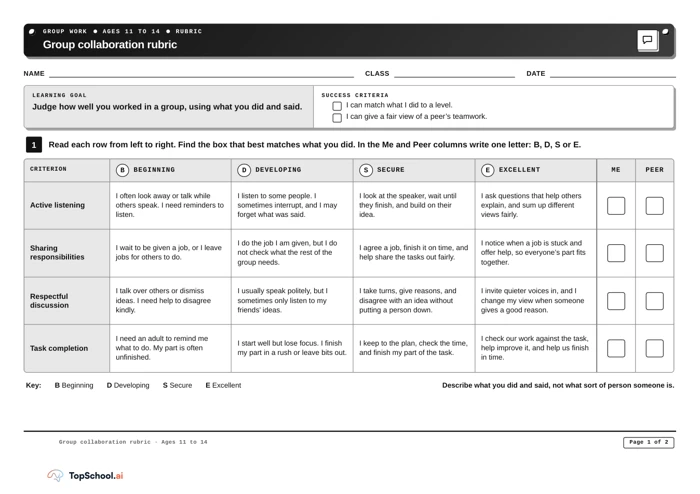
Use four criteria to reflect on active listening, sharing responsibilities, respectful discussion and task completion. Pupils record evidence about their own and a peer’s contribution, then identify what went well and agree one target for the group.
Read the material
Use four criteria to reflect on active listening, sharing responsibilities, respectful discussion and task completion. Pupils record evidence about their own and a peer’s contribution, then identify what went well and agree one target for the group.
Complete resource. Use the preview for diagrams and layout.
Page 1
NAME
CLASS
DATE
LEARNING GOAL
Judge how well you worked in a group, using what you did and said.
SUCCESS CRITERIA
I can match what I did to a level.
I can give a fair view of a peer’s teamwork.
1
Read each row from left to right. Find the box that best matches what you did. In the Me and Peer columns write one letter: B, D, S or E.
CRITERION
B
BEGINNING
D
DEVELOPING
S
SECURE
E
EXCELLENT
ME
PEER
Active listening
I often look away or talk while
others speak. I need reminders to
listen.
I listen to some people. I
sometimes interrupt, and I may
forget what was said.
I look at the speaker, wait until
they finish, and build on their
idea.
I ask questions that help others
explain, and sum up different
views fairly.
Sharing
responsibilities
I wait to be given a job, or I leave
jobs for others to do.
I do the job I am given, but I do
not check what the rest of the
group needs.
I agree a job, finish it on time, and
help share the tasks out fairly.
I notice when a job is stuck and
offer help, so everyone’s part fits
together.
Respectful
discussion
I talk over others or dismiss
ideas. I need help to disagree
kindly.
I usually speak politely, but I
sometimes only listen to my
friends’ ideas.
I take turns, give reasons, and
disagree with an idea without
putting a person down.
I invite quieter voices in, and I
change my view when someone
gives a good reason.
Task completion
I need an adult to remind me
what to do. My part is often
unfinished.
I start well but lose focus. I finish
my part in a rush or leave bits out.
I keep to the plan, check the time,
and finish my part of the task.
I check our work against the task,
help improve it, and help us finish
in time.
Key:
B Beginning
D Developing
S Secure
E Excellent
Describe what you did and said, not what sort of person someone is.
Group collaboration rubric · Ages 11 to 14
Page 1 of 2
GROUP WORK
AGES 11 TO 14
RUBRIC
Group collaboration rubric
Page 2
NAME
CLASS
DATE
OUR GROUP TASK
Group collaboration rubric · Ages 11 to 14
Page 2 of 2
GROUP WORK
AGES 11 TO 14
REFLECTION
Our group reflection
1
Evidence for each criterion
Active listening
One moment that shows this:
Sharing responsibilities
One moment that shows this:
Respectful discussion
One moment that shows this:
Task completion
One moment that shows this:
2
Looking back
What went well
Even better if
3
Our group target for next time
Next time we will...
A teaching sequence
Use specific examples to reflect on collaboration and choose a practical group target for next time.
Read the task criteria
Review the four criteria and the descriptions from Beginning to Excellent. Discuss what each level might look like during the task.
What observable action could illustrate this criterion?
Select a level with evidence
Choose self-reflection levels after the activity and record one supporting moment. If peer reflection is appropriate, ask for an observable action, without judging character or requiring eye contact as proof of listening.
Which moment supports the choice without judging character or requiring eye contact?
Reflect on the work
Complete the “what went well” and “even better if” prompts. Use examples from the task rather than general labels.
What specific task example explains what went well or needs adjustment?
Agree a group next step
Agree one group target for the next task and identify a step each member can take. Link the target to a group action.
What action can each member take towards the shared target?
Before you teach
Look for the thinking behind an answer, choose the support your class needs and leave room for an independent response.
What to look for
Look for evidence linked to the criterion, such as waiting for a speaker to finish, completing an agreed role or checking work against the task. Check that peer feedback is specific and respectful. Ask whether the target is within the group’s control and includes an action they can try.
Give a little support
Use a recent task as a shared example and model one piece of evidence before pupils rate. Offer private or teacher-supported reflection instead of peer ratings where needed. Accept different communication styles as evidence of listening; pupils can show attention without looking at a speaker.
Take the idea further
Ask pupils to compare the group’s target with what happened in a later task. They can select a criterion to track and describe one change in how responsibilities were shared or how ideas were discussed.
Things to keep in mind
The rubric is a prompt for reflection, not a measure of a pupil’s character or ability. A single task cannot show a full pattern of collaboration. Use criteria flexibly and do not treat eye contact, speaking frequency or speed as the only signs of participation.
Keep the idea. Make it yours.
Bring your topic, learning goal and class context to PLAI™, then review what you create.
Ideas to try with your class
Sample teaching perspectives on what to try, what to adapt and what to watch for.
Meet The Creators
Meet a creator whose teaching interests connect with this template.

One Last Sticky Note
The rubric describes four levels across listening, sharing responsibilities, respectful discussion and task completion, then asks for a letter in both Me and Peer columns. Its final reflection should connect an example to a practical group target.
Thoughtful Pause
This is a self- and peer-reflection tool, not simply a group mark. The descriptors distinguish waiting for a task from helping share work, and polite disagreement from inviting quieter voices or changing a view for a reason.
Helpful Highlighter
Read a criterion and ask for a specific example before choosing a level. That can make peer feedback more grounded and less personal, while allowing a pupil to select one next action for group work.
Reread Reminder
Peer ratings can affect relationships if treated as public scores. Use the rubric with clear adult guidance, protect individual responses and review the descriptors for fairness before using them to judge collaboration.