
Languages and literacy
Four sentence types: recognise and punctuate
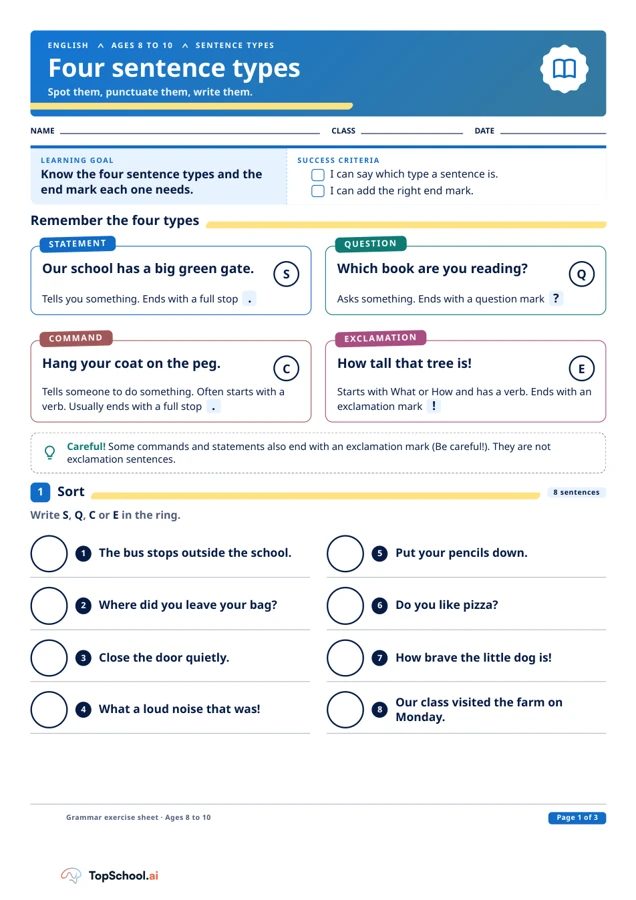
Recognise statements, questions, commands and exclamations, then practise choosing the correct end mark. Each type has a different purpose; punctuation alone does not define it. Pupils write examples about a school trip topic.
Read the material
Recognise statements, questions, commands and exclamations, then practise choosing the correct end mark. Each type has a different purpose; punctuation alone does not define it. Pupils write examples about a school trip topic.
Complete resource. Use the preview for diagrams and layout.
Page 1
NAME
CLASS
DATE
LEARNING GOAL
Know the four sentence types and the
end mark each one needs.
SUCCESS CRITERIA
I can say which type a sentence is.
I can add the right end mark.
Remember the four types
Careful! Some commands and statements also end with an exclamation mark (Be careful!). They are not
exclamation sentences.
1
Sort
8 sentences
Write S, Q, C or E in the ring.
1
The bus stops outside the school.
5
Put your pencils down.
2
Where did you leave your bag?
6
Do you like pizza?
3
Close the door quietly.
7
How brave the little dog is!
4
What a loud noise that was!
8
Our class visited the farm on
Monday.
Grammar exercise sheet · Ages 8 to 10
Page 1 of 3
ENGLISH
AGES 8 TO 10
SENTENCE TYPES
Four sentence types
Spot them, punctuate them, write them.
Our school has a big green gate.
S
Tells you something. Ends with a full stop .
STATEMENT
Which book are you reading?
Q
Asks something. Ends with a question mark ?
QUESTION
Hang your coat on the peg.
C
Tells someone to do something. Often starts with a
verb. Usually ends with a full stop .
COMMAND
How tall that tree is!
E
Starts with What or How and has a verb. Ends with an
exclamation mark !
EXCLAMATION
Page 2
2
Add the end punctuation
6 sentences
These sentences have no end mark. Write the right one in the box.
a
Can I borrow your ruler
d
The cat sleeps on my bed
b
Please sit down
e
How kind you are
c
What a beautiful sunset that is
f
Is it time for lunch
3
Turn the statement into a question
3 sentences
Write the question. Start with a capital letter and end with the right mark.
a
You are hungry.
b
The shop opens at nine.
c
Tom can swim.
4
Find the bossy verb
3 commands
A command starts with a bossy verb. Circle it.
a
Mix the flour and the eggs.
b
Look at the board.
c
Walk to the hall.
5
Fix the mistake
3 sentences
Each sentence has the wrong end mark. Write it again with the right one.
a
Where is the library.
b
What a mess it is.
c
Open your books?
Grammar exercise sheet · Ages 8 to 10
Page 2 of 3
ENGLISH
AGES 8 TO 10
SENTENCE TYPES
Change, find and fix
Questions, commands and end marks.
Page 3
6
Write your own
4 sentences
Write four sentences about a school trip. Write one of each type. Question starters: Who, What, Where,
Why, Is, Can, Do.
GO FURTHER
Write about the weather on your trip. Start one exclamation with What and one with How.
Check your work
Each sentence has the right end mark.
Each sentence is the type I chose.
My exclamations start with What or How.
How did you do?
Not yet
Getting there
Got it
Grammar exercise sheet · Ages 8 to 10
Page 3 of 3
ENGLISH
AGES 8 TO 10
SENTENCE TYPES
Write your own
Four sentences about a school trip.
Statement:
Question:
Command:
Exclamation:
What
How
A teaching sequence
Identify four sentence types and use suitable end punctuation in a set of examples and original sentences.
Hear each sentence's purpose
Sort the eight page-one sentences by purpose and write the matching letter. Add end marks to the six page-two sentences, reading aloud to distinguish telling, asking, directing and exclaiming.
Does it tell, ask, direct or exclaim?
Turn statements into questions
Rewrite three statements as questions, beginning with a capital letter and ending with a question mark.
What changed in the word order as well as the end mark?
Find verbs and fix marks
Find the action verb in each command and correct the punctuation in three sentences with an incorrect end mark.
Which action does the command ask someone to take?
Write four kinds
Write one school-trip sentence of each type and check its end mark. Begin the further exclamations with What or How and explain their purpose.
Can a command end with an exclamation mark and remain a command?
Before you teach
Look for the thinking behind an answer, choose the support your class needs and leave room for an independent response.
What to look for
Check that the sentence type matches its purpose and that the punctuation mark is appropriate. Commands can end with a full stop or, when emphasis is intended, an exclamation mark; that does not make them exclamation sentences. Look for a complete verb in the exclamation examples.
Give a little support
Read examples aloud and use colour to match sentence purpose with punctuation. Offer sentence starters for questions and commands, and let pupils rehearse a sentence orally before writing. Use a small set of examples first, then gradually remove prompts.
Take the idea further
Ask pupils to write a short school-trip paragraph that includes all four types and explain why each end mark fits. They can compare a command with an exclamatory statement to show why the punctuation mark alone does not determine sentence type.
Things to keep in mind
The worksheet teaches a basic four-type model and common end marks. Punctuation conventions can be more nuanced, and commands or statements may use an exclamation mark for emphasis. Use the lesson context to discuss tone and meaning.
Keep the idea. Make it yours.
Bring your topic, learning goal and class context to PLAI™, then review what you create.
Ideas to try with your class
Sample teaching perspectives on what to try, what to adapt and what to watch for.
Meet The Creators
Meet a creator whose teaching interests connect with this template.

Glue Stick Club
The three-page exercise distinguishes statements, questions, commands and exclamations, with a specific warning that commands and statements can also end in an exclamation mark. Pupils sort examples, add punctuation and rewrite sentences.
Pencil Case Pal
For ages 8 to 10, the sequence moves from recognising sentence purpose to choosing an end mark and changing a statement into a question. The warning prevents punctuation alone from determining the sentence category.
Bright Margins
The model definition for each type pairs a purpose with an example, such as a question asking something. Have pupils explain what the sentence is doing before choosing S, Q, C or E.
Quietly Curious
An exclamation mark does not automatically make a sentence an exclamation type, as the sheet notes. Check the purpose and grammar of each example, and extend beyond the eight sorting sentences for broader assessment.