
Languages and literacy
Assignment revision prompt cards
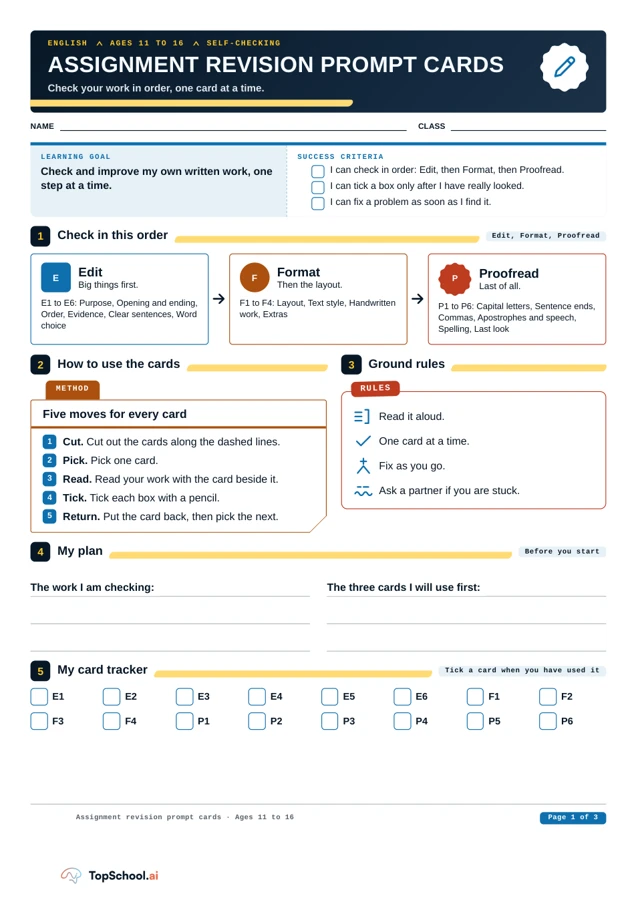
Help pupils review writing in a deliberate order: edit the ideas and evidence, check the format, then proofread. The three-page A4 set includes a plan and tracker plus sixteen cut-out cards with focused checks for each stage.
Read the material
Help pupils review writing in a deliberate order: edit the ideas and evidence, check the format, then proofread. The three-page A4 set includes a plan and tracker plus sixteen cut-out cards with focused checks for each stage.
Complete resource. Use the preview for diagrams and layout.
Page 1
NAME
CLASS
LEARNING GOAL
Check and improve my own written work, one
step at a time.
SUCCESS CRITERIA
I can check in order: Edit, then Format, then Proofread.
I can tick a box only after I have really looked.
I can fix a problem as soon as I find it.
1
Check in this order
Edit, Format, Proofread
E
Edit
Big things first.
E1 to E6: Purpose, Opening and ending,
Order, Evidence, Clear sentences, Word
choice
F
Format
Then the layout.
F1 to F4: Layout, Text style, Handwritten
work, Extras
Proofread
Last of all.
P1 to P6: Capital letters, Sentence ends,
Commas, Apostrophes and speech,
Spelling, Last look
2
How to use the cards
3
Ground rules
4
My plan
Before you start
5
My card tracker
Tick a card when you have used it
E1
E2
E3
E4
E5
E6
F1
F2
F3
F4
P1
P2
P3
P4
P5
P6
Assignment revision prompt cards · Ages 11 to 16
Page 1 of 3
ENGLISH
AGES 11 TO 16
SELF-CHECKING
ASSIGNMENT REVISION PROMPT CARDS
Check your work in order, one card at a time.
P
Five moves for every card
METHOD
Cut. Cut out the cards along the dashed lines.
1
Pick. Pick one card.
2
Read. Read your work with the card beside it.
3
Tick. Tick each box with a pencil.
4
Return. Put the card back, then pick the next.
5
Read it aloud.
One card at a time.
Fix as you go.
Ask a partner if you are stuck.
RULES
The work I am checking:
The three cards I will use first:
Page 2
Cut along the dashed lines. The letter and shape show the set: E square, F circle, P scalloped.
E1
Purpose
I re-read the task or brief.
Every part of the task is covered.
I can say my main point in one sentence.
I cut anything that does not help.
E2
Opening and ending
My opening sets out my point or draws the reader in.
My ending links back to the task.
My ending is not just my opening repeated.
No new, unexplained idea appears at the end.
E3
Order
Each paragraph has one main idea.
Ideas are in a sensible order.
Linking words show how ideas connect (so, because,
however, for example).
I moved or removed anything out of place.
E4
Evidence
Each point is backed by an example, fact or quotation.
I explained how the evidence supports the point.
I checked facts against my notes or source.
I named my sources where needed.
E5
Clear sentences
I read it aloud and marked places where I ran out of
breath.
I split any sentence that tries to do too much.
I cut words that say the same thing twice.
Every sentence says what I mean.
E6
Word choice
I replaced vague words (thing, nice, good, got) with
exact ones.
I used subject words from the unit correctly.
My tone suits my reader.
I do not repeat the same word again and again.
F1
Layout
The title is clear.
My name and the date are in place, if asked.
Paragraphs are separated by a gap or a new line.
Margins and spacing are tidy.
F2
Text style
Body text is one font and one size.
All headings look the same.
Bold or underline is used only for a reason.
Lists follow one style.
Assignment revision prompt cards · Ages 11 to 16
Page 2 of 3
ENGLISH
AGES 11 TO 16
SELF-CHECKING
CARDS: EDIT AND FORMAT
Cut out, pick one, tick each box.
Page 3
Cut along the dashed lines. The letter and shape show the set: E square, F circle, P scalloped.
F3
Handwritten work
My writing is clear to read.
I wrote on every line and left space for comments, if
asked.
I crossed out mistakes neatly with one line.
I drew diagrams in pencil first and labelled them with a
ruler.
F4
Extras
Pictures, tables and graphs have a title or caption.
Sources are listed the way my teacher asked.
Pages are numbered if there is more than one.
I checked any word limit my teacher set.
Capital letters
Every sentence starts with a capital letter.
Names of people and places have capitals.
The word I is always a capital.
No capitals appear by mistake in the middle of
sentences.
Sentence ends
Every sentence ends with . or ? or !
I checked for two sentences joined by only a comma.
Every sentence has a verb.
I checked for sentences that stop too soon.
Commas
Commas separate items in a list.
There is a comma after an opening phrase (After lunch,
we left).
Commas go round extra information.
There is no comma between a subject and its verb.
Apostrophes and speech
Apostrophes show missing letters (don’t, it’s for it is).
Apostrophes show belonging (the girl’s coat).
There is no apostrophe in a plain plural (apples) or in its
meaning belonging to it.
Speech marks surround spoken words, with a new line
for a new speaker.
Spelling
I underlined words I am unsure of and checked them.
I checked words that sound alike (their, there, they’re;
your, you’re).
I checked subject words against my notes.
I checked endings such as -ed and -ing.
Last look
I read it aloud one last time.
I read the last sentence first, then the one before, to
spot spelling slips.
I looked for missing words.
A partner read one paragraph for me.
Assignment revision prompt cards · Ages 11 to 16
Page 3 of 3
ENGLISH
AGES 11 TO 16
SELF-CHECKING
CARDS: FORMAT AND PROOFREAD
Cut out, pick one, tick each box.
P1
P2
P3
P4
P5
P6
A teaching sequence
Review a draft in order by checking its purpose and ideas, its format and then its spelling and punctuation.
Edit the main ideas
Edit first: check the task purpose, opening and ending, order, evidence, clear sentences and word choice using cards E1-E6.
Which card shows a gap between your work and the task brief?
Check the presentation
Format next: use cards F1-F4 to check layout, text style, handwriting and extras such as captions, sources, page numbers or word limits.
Which caption, source or layout requirement does your teacher's task specify?
Proofread one feature at a time
Proofread last with cards P1-P6, checking capitals, sentence ends, commas, apostrophes and speech, spelling and a final read.
What did the final read reveal that the earlier checks missed?
Record completed checks
Tick only checks actually completed, fix problems as they appear and return each card to its set. Review the change and decide whether teacher feedback is still needed.
Which card helped you find a problem you actually fixed?
Before you teach
Look for the thinking behind an answer, choose the support your class needs and leave room for an independent response.
What to look for
Look for evidence that pupils checked content and organisation before surface corrections, and can point to a change they made. Ask: “Which card helped you find a problem you had missed?” A tick records self-review, not proof that every correction is accurate; teacher feedback may still be needed.
Give a little support
Use one card at a time, read the checklist aloud and provide a short draft paragraph for a shared model. Pupils can focus on two cards selected for the task rather than completing every card in one sitting.
Take the idea further
Invite pupils to compare an early and revised paragraph and explain which card prompted the most useful change. They can create one additional task-specific check, such as verifying a quotation or testing whether a conclusion answers the question.
Things to keep in mind
The cards are self-check prompts, not an answer key or substitute for subject-specific review. Some checks depend on a teacher’s task instructions, such as sources or word limits. Cutting, storage and how much to complete should be decided for the lesson.
Keep the idea. Make it yours.
Bring your topic, learning goal and class context to PLAI™, then review what you create.
Ideas to try with your class
Sample teaching perspectives on what to try, what to adapt and what to watch for.
Meet The Creators
Meet a creator whose teaching interests connect with this template.

Pencil Case Pal
The cards prescribe Edit, Format, then Proofread, with numbered checks such as purpose and evidence before spelling and punctuation. The tracker lets a pupil choose and tick cards after actually rereading the work, instead of applying a generic checklist all at once.
Quietly Curious
For ages 11 to 16, the cut-out cards separate large-scale revision from layout and final proofreading. Reading aloud and fixing a problem as it appears give the sequence an active routine for revising an existing assignment.
Helpful Highlighter
The five moves on each card reduce the task to one prompt at a time, and the plan box asks which three cards to use first. A partner can help when the pupil is stuck without taking over the edits.
Steady Marker
The card set can guide checking but cannot confirm the accuracy or quality of a claim. The pupil still needs the assignment brief and any subject-specific criteria beside the cards, especially when checking evidence.