
Languages and literacy
Argument and debate planning frame
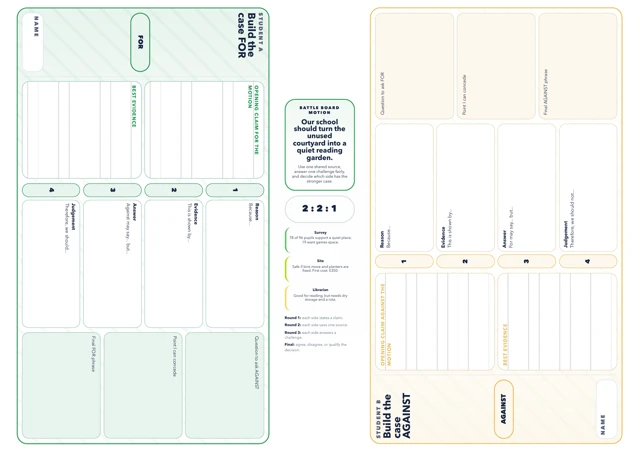
Help two pupils prepare opposite cases, question each other fairly and reach a reasoned judgement. An A3 board gives each side a matching structure for claims, evidence, replies and concessions, alongside a shared courtyard-garden scenario and debate sequence.
Read the material
Help two pupils prepare opposite cases, question each other fairly and reach a reasoned judgement. An A3 board gives each side a matching structure for claims, evidence, replies and concessions, alongside a shared courtyard-garden scenario and debate sequence.
Pupil debate board, A3. Use the preview for diagrams and layout.
Page 1
Battle board
Motion
Our school should turn the unused courtyard into a quiet reading garden.
Use one shared source, answer one challenge fairly, and decide which side has the stronger case.
2 : 2 : 1

Sources
Survey: 78 of 96 pupils support a quiet place; 19 want games space.
Site: Safe if bins move and planters are fixed. First cost: £350.
Librarian: Good for reading, but needs dry storage and a rota.

Debate sequence
Round 1: each side states a claim.
Round 2: each side uses one source.
Round 3: each side answers a challenge.
Final: agree, disagree, or qualify the decision.

Student A
Build the case FOR
FOR
Name
Opening claim for the motion
Best evidence
1. Reason
Because...
2. Evidence
This is shown by...
3. Answer
Against may say... but...
4. Judgement
Therefore, we should...
Question to ask AGAINST
Point I can concede
Final FOR phrase

Student B
Build the case AGAINST
AGAINST
Name
Opening claim against the motion
Best evidence
1. Reason
Because...
2. Evidence
This is shown by...
3. Answer
For may say... but...
4. Judgement
Therefore, we should not...
Question to ask FOR
Point I can concede
Final AGAINST phrase
A teaching sequence
Build and respond to an argument using relevant evidence, a fair challenge and a reasoned final judgement.
Prepare both sides
Assign FOR and AGAINST roles and give both pupils time to prepare an opening claim and strongest evidence from the shared scenario.
What is each side's strongest source from the shared scenario?
State and support a claim
In the first round, state each claim. In the second, point to one scenario source and explain how it supports the reason.
How does the cited figure or condition support your reason?
Answer and concede fairly
In the third, ask each side to answer the other’s challenge fairly and identify a point it can concede.
Which part of the other side's challenge can you reasonably concede?
Reach a qualified judgement
Agree, disagree or qualify the decision using the accurately labelled scenario figures. Identify which evidence most affected the judgement.
Which scenario evidence changed or qualified your position?
Before you teach
Look for the thinking behind an answer, choose the support your class needs and leave room for an independent response.
What to look for
Look for a claim supported by a source detail, a fair response to the opposite case and a conclusion that reflects the discussion. Ask: “Which piece of evidence changed or qualified your position?” The embedded scenario data must be verified or clearly labelled before pupils treat it as real-world evidence.
Give a little support
Provide the shared scenario text in a readable form and model one evidence-based reason before pupils prepare. Offer sentence starters for conceding a point and responding politely; allow pupils to jot notes before speaking. Confirm scenario figures first.
Take the idea further
Invite pupils to write a short reasoned recommendation that acknowledges a strong objection and names one piece of evidence they would still need before a real decision. Do not use unverified scenario figures as the basis for an actual school proposal.
Things to keep in mind
A debate board offers structure, but groups still need adult facilitation to share time fairly and challenge ideas respectfully.
Keep the idea. Make it yours.
Bring your topic, learning goal and class context to PLAI™, then review what you create.
Ideas to try with your class
Sample teaching perspectives on what to try, what to adapt and what to watch for.
Meet The Creators
Meet a creator whose teaching interests connect with this template.
Five More Minutes
The courtyard motion has shared prompts about a pupil survey, site safety, cost and the librarian’s storage and rota concerns; the two student panels ask for a claim, evidence, challenge and judgement. The 78/96 and 19 figures need careful handling.
Board Eraser
The 2:2:1 rounds give each side a turn to state a claim, use a source and answer a challenge before deciding. The “point I can concede” field encourages a reasoned position rather than a debate built only on rebuttals.
Quietly Curious
The paired FOR and AGAINST layouts help learners prepare their own side while anticipating the other. Teachers can model one evidence line from the shared prompts and let pupils rehearse their answer aloud before writing.
One Last Sticky Note
The survey reports 78 of 96 pupils support a garden and 19 want games space, but it does not say whether those groups overlap. Clarify the survey question and categories before treating the counts as mutually exclusive.